
Overall, volume growth is likely to be in the range of 3-8 per cent for two-wheelers and 5-7 per cent for passenger vehicles owing to healthy demand from urban and rural areas and pending order books.
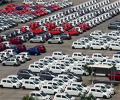
Passenger vehicle sales are expected to experience muted growth in the current financial year.
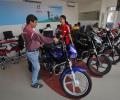
India's largest two-wheeler maker by volume - Hero MotoCorp (Hero) - posted a better-than-expected operating performance in the January-March (fourth quarter, or Q4) quarter of 2022-23 (FY23). Riding on higher average selling prices which were up 5 per cent year-on-year (YoY) and volume growth of 7 per cent, the company registered a 12 per cent growth in revenue to Rs 8,306 crore. The company sold 127,000 units in the quarter, largely driven by domestic sales which were up 11.6 per cent, while exports saw a sharp fall of 57 per cent over the year-ago quarter.
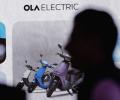
Ola Electric's latest MoveOS 5 upgrade delivers sharper performance on its Gen 3 platform due to an optimised in-house Motor Control Unit that enhances range and responsiveness.
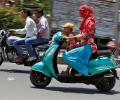
The two-wheeler sector has been underperforming its peers on the volumes front for over five quarters now. Even in the March quarter, Bajaj Auto and Hero MotoCorp posted a 17-24 per cent YoY decline in volumes, the sharpest in the listed auto universe. The ongoing impact of frequent price hikes, all-time high fuel prices, and muted rural sentiment has led to the lacklustre showing by two-wheeler makers. What has aggravated the situation for two-wheeler companies, which get almost all their sales from the internal combustion engine or ICE-based units, is the traction for electric two-wheelers (EV).

In doing so, Bajaj has become the first internal combustion engine two-wheeler company to launch an all-electric two-wheeler in India.
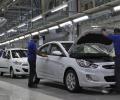
Domestic passenger vehicle (PV) sales saw a significant growth in October due to increased availability of semiconductor chips and rising consumer confidence. The sales figures during the month - which coincided with the first post-Covid festival season - released by the top ten carmakers saw a jump of 30.7 per cent to 322,885 units in October. Auto companies count wholesales - units dispatched to dealers - as sales.

Mopeds are sought by people with smaller businesses, with their weight-carrying and haulage ability beside being lighter and easy to manoeuvre in traffic.

Auto firms are likely to perform better in coming months.
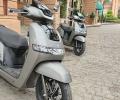
'Price competition is fierce, with many companies selling at zero margin.' 'This pricing pressure is challenging smaller companies and will likely drive some out of the market over time.'
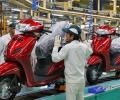
Honda Motorcycle and Scooter India (HMSI), the country's second-largest two-wheeler manufacturer, is planning to launch its first electric vehicle (EV) here by March next year, said CEO & MD Atsushi Ogata on Monday. The company would also enter the low-end motorcycle market in March by launching a 100cc engine bike at a price that will "positively shock" customers, he said while speaking with reporters, after launching the Activa with Honda Smart Key. HMSI's first EV, an electric scooter, will have a fixed battery and the second model will have two swappable batteries, Ogata explained.

The environment ministry is likely to soon issue regulations that will mandate automakers to recycle a specified percentage of steel from old vehicles, starting from the next financial year, according to people familiar with the matter. "We recently held a meeting with members of the Society of Indian Automobile Manufacturers (Siam). "The final regulations are likely to be issued in the next 10 days," a government source informed.

The damage to aircraft estimated to be around Rs 200 crore.
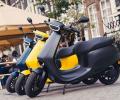
Under regulatory scanner, Bengaluru-based Ola Electric has witnessed an uptick in its sales after facing a decline during the last few months. The company's daily average sales rose to 1,154 units in October, according to Vahan data from the Ministry of Road Transport and Highways (MoRTH). With sales reaching 17,315 units between October 1 and October 15, the company has also boosted its market share to 34 per cent, up from 27 per cent in September, in the electric two-wheeler (e2W) segment.

The Ministry of Heavy Industries has approved 11 electric vehicle (EV) manufacturers, including Ather Energy, Bajaj Auto, Hero MotoCorp, Ola Electric, and Mahindra, to receive incentives under the recently introduced Electric Mobility Promotion Scheme (EMPS) 2024. "A total of 11 firms have been granted approval under the EMPS, with several more under consideration," informed a senior official of the ministry to Business Standard. The scheme aims to sustain the growth in EV sales, replacing the Faster Adoption and Manufacturing of Electric Vehicles - II (FAME-II) scheme.

Overseas shipments at auto firms expanded at a brisk pace year-on-year (YoY) in March, bumping up the overall annual exports for FY22 and taking it to a record level for some like Maruti Suzuki India and Bajaj Auto. Amid a semiconductor shortage, a depreciating rupee and a strong demand in various export destinations, passenger vehicle makers diverted capacity meant for the local market in favour of the more-lucrative export market. Among the passenger vehicle makers, market leader Maruti Suzuki led the rally with its overseas shipments touching a record level of 238,376 units in FY22 - the highest for the company in any financial year.
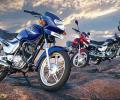
To be launched in early 2016, TVS is planning to introduce a new 125cc motorcycle as part of its new product strategy
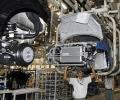
Hyundai Motor and Toyota Kirloskar Motor have announced the suspension of manufacturing operations at their respective plants amid coronavirus outbreak. On Sunday, various automakers like Maruti Suzuki India, Honda Cars, Mahindra & Mahindra and Fiat announced a temporary halt in manufacturing operations at their respective facilities.

To take on Bajaj Pulsar 180 and Hero Karizma R and to celebrate the release of X-Men -- Days of Future Past, TVS has launched Apache RTR 180 Matte Black Edition. But will it succeed?
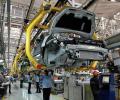
The K-shaped economic recovery in India from the pandemic slowdown shows in corporate results as well. The automobile sector, which represents big-ticket consumption, continues to do well and has increased its share in corporate revenues and profits while fast-moving consumer goods (FMCG) companies that sell low-ticket consumer goods are struggling with poor sales and earnings growth. The share of the automobile sector, including makers of auto ancillaries, in corporate net sales rose to a 10-quarter high of 10.05 per cent during July-September 2023 (Q2FY24) from 8.94 per cent a year earlier and 9.75 per cent in Q1FY24.
Take the Rediff Biz Quiz and find out how much you know about India and its two-wheeler companies.

Industry leaders on Thursday mourned the death of Ratan Tata saying with his demise India has lost a visionary who shaped its industrial and philanthropic landscape. Tata was a truly remarkable business leader who placed the country before business interests, and whose vision was truly transformational for a country and its people, TVS Motor Co Chairman Emeritus Venu Srinivasan said in a statement. "Mr Tata was a truly remarkable business leader, the likes of whom nations get only once in a century," he added.
Amid rising petrol prices, two-wheeler makers such as Mahindra & Mahindra, TVS Motors, Hero MotoCorp and Bajaj Auto are stepping up research to develop engines run on diesel or other fuels.

SoftBank-backed Ola Electric took the wraps off its maiden e-scooter offerings -- Ola S1 and S1 Pro -- for a commercial launch on Sunday. With prices starting from Rs 99,999 (excluding state government incentives, registration fee, and insurance cost), the Bhavesh Aggarwal-founded firm said the e-scooters are designed and engineered in India for the world and will deliver the best scooter experience to the consumer. He suggested that after 2025, sale of petrol-powered two-wheelers should not be allowed.
A majority of HMIL's current export comprises the i10 model, which is exported to Asia, Latin America and Western Europe. In addition, the company has stated that 90 per cent of the i20 model (a premium hatchback) will be exported. The company will produce 150,000 units of the model annually.

Vehicle sales across categories registered a decline of 8.62 per cent to 20,86,358 units from 22,83,262 units in May 2018.
To regain its number 3 position from TVS Motor, the Chakan-based two-wheeler manufacturer will soon be launching Discover 150 S and 150 F priced at Rs 64,000 and Rs 68,000 respectively.

Experts attribute the high valuation of Indian auto makers to the faster growth in India compared to the rest of the world.

Low-base effect to kick in, but higher raw material prices could spoil the show.

Consumer sentiments have been dampened due to several factors like tight liquidity, high insurance, and high costs
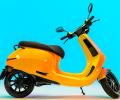
The entry of SoftBank-backed Ola into the electric scooter (e-scooter) segment is set to power up the overall market and perhaps fast-track the adoption of battery-operated vehicles. But for manufacturers of internal combustion engine (ICE)-powered two-wheelers, such as Bajaj Auto, Hero MotoCorp, and TVS Motor, it will be a double whammy. Not only will they have to contend with the aggressive pricing of Ola's scooter and incur a loss at each unit of the e-scooter sold, the volumes of their regular (ICE) models, too, could feel the squeeze, observed analysts. Ola is expected to price its e-scooter in the range of Rs 85,000-1.1 lakh.
Automakers Maruti Suzuki, Tata Motors, Mahindra & Mahindra and Kia reported robust growth in their vehicle dispatches in the domestic market for August buoyed by festive demand and easing of semiconductor shortage woes. Other manufacturers like Hyundai, Toyota and Skoda also reported growth in wholesales in August as compared with the same month last year. The country's largest automaker Maruti Suzuki India said its domestic passenger vehicle dispatches increased by 30 per cent to 134,166 units in August as compared with 103,187 units in the year-ago month.
FMCG players -- Dabur, HLL, PSU BPCL, Korean car maker Hyundai, liqour barron Vijay Malaya's Mcdowell and TVS motors -- are among the major companies found to violate Advertising Standards Council of India code.

Of the 32 students, 28 self-sponsored students were successfully placed in manufacturing companies like Crompton, McNallyBharat, Cummins, Hewlett-Packard, JSW, VNL (Gurgaon), TVS Motor, PricewaterhouseCoopers, Ashok Leyland, Vedanta and Adani Power, among others.

Take out Maruti Suzuki and Honda, and the auto sector's prospects suddenly don't look all that rosy.

Passenger vehicle wholesales in India increased by 12.73 per cent to 285,367 units in November as against 253,139 units in the same month last year riding on the back of festive demand, auto industry body SIAM said on Friday. According to the latest data by the Society of Indian Automobile Manufacturers (SIAM), two-wheeler sales rose 13.43 per cent to 16,00,379 units, compared with 14,10,939 units in the same month last year.

Passenger vehicle wholesale in India increased by 14.19 per cent to 3,10,294 units in October against 2,71,737 units in the same month last year as companies despatched more units to dealers to cater to enhanced demand in the festive season, auto industry body SIAM said on Wednesday. According to the latest data by the Society of Indian Automobile Manufacturers (SIAM), two-wheeler sales also rose 16.88 per cent to 20,53,814 units, compared with 17,57,180 units in the same month last year. Motorcycle sales were at 13,82,749 units as against 11,16,886 units in October 2019, up 23.8 per cent.
Electric two-wheelers have zipped past the half-a-million registration mark and achieved a market penetration of 4 per cent at the fag end of Calendar 2022, according to data released by VAHAN. According to VAHAN data for the year (until December 27), 560,000 two-wheelers were registered in the country, up a staggering fourfold over 2021, when only 136,000 were registered, and when electric vehicle penetration was a mere 1.05 per cent. The total number of two-wheelers (internal combustion engine, or ICE, and electric) registered so far in 2022 stands at 14.5 million, up only 12.7 per cent over the previous calendar year.
A majority of CEOs from top Indian companies including ICICI Bank, Bajaj Auto, TVS Motor GE India, and HUL, do not foresee any production slowdown in this fiscal, even as rising input and interest costs are affecting the net profit margins, a CII survey has found.
